Off the Grid!
Ozdachs is on vacation and completely away from the Internet!
We’ll be back Thursday, May 19th. There are some posts scheduled while we’re away, but responses to your email or comments will happen after we’re back.


Ozdachs is on vacation and completely away from the Internet!
We’ll be back Thursday, May 19th. There are some posts scheduled while we’re away, but responses to your email or comments will happen after we’re back.
I am a fan of using third-party tools and pre-developed solutions instead of developing new features for clients.
Why?
This month I found and used a free script from Yahoo! that allows people to click a button to hear a streamed sermon by Rev. Mary Moore, a minister for whom I just finished a web site.
Locating the tool, implementing on the client’s web site, and testing it took less than an hour. Spectacular!
Of course, with third-party products, especially those that are free, we’ll have to check periodically to make sure that they’re still working as we expect. In the case of Rev. Moore’s web site, the critical period of it to be working is a two-week period every two years… not a very stringent testing requirement.
I regularly use a third-party menu-building tool (see left-hand navigation on Rev. Moore’s site for an example of that feature). I also use a third-party form creator for displaying forms and emailingthe filled-in data to the appropriate person (see Rev. Moore’s contact page for a sample form from that tool).
It’s not that I cannot code. I was an assembly language programmer in my early career.
But paying for the time spent coding custom applications is beyond the budget of most of my clients. Plus, third parties who specialize in a particular function are likely to have designed and tested their product much more thoroughly than I could for a one-time use.
If you’re working with a web designer who wants to build a custom solution, call me first. I’m happy to tell you what third-party application I’d use, where to look for already-created tools, or else applaud your designer for tackling a truly unique situation.
Cisco announced today that it is discontinuing the Flip video camera. This is quite a turnaround from 2009 when Cisco bought the company that produced the super-cool device for $590 million. Some write-down!
Wired magazine suggests that the Flip is being killed because its sales have fallen and it’s past its moment of coolness. I think they’re on to something, but it’s not just about the Flip. It’s about large corporations overpaying for something unique and cool, corporatizing the soul out of it, and then having to unload the non-performing asset at bargain prices.
The Flip is/was a smart idea. But Cisco didn’t keep the brand on the edge of technology. There’s no button to upload over the air to Facebook, or something like that. The 2011 Flip is the 2009 Flip. There’s no Flip momentum in the Flip.
Yet, if Cisco had kept its hands off the camera, I’m betting we all would be wanting a Flip. But, a Cisco Flip just doesn’t have the spunk — rosy sale future — that corporate overlords require.
As it is, the Flip is in demand. I tried to order two this afternoon from Amazon.com. Amazon refused, saying that they were limiting Flips to one per client.
With that type of restriction, Flip doesn’t sound like a failure.
Last week I was asked to talk to the Fog City BNI group and tell them how they can get their businesses to show up higher in search engine results.
Here’s almost 10 minutes of basic things you can do — or make sure that your web person does. None of these tips are expensive, and they work!
 Yesterday’s news was sprinkled with references to Federal anti-trust regulators looking into various aspects of Google’s business.
Some arm of some agency was looking into Google’s purchase of another software company while the Feds elsewhere were pondering the fairness of Google’s search results.
I was listening to the almost gloating radio news reports about Google’s woes as I was trying to help a couple clients gain visibility on the Internet.
I had no problem adding my clients to Google’s places and on Yelp. But, as I was listening to moaning from Google’s competitors who suspect Google of improper market control, I was having my own problems with Google’s most formidable search competitor, Bing.
Adding the first client to Bing seemed to be going well. I spent several minutes going through screens adding location details on this page, opening hours on another page, and service details and firm history on following pages. I uploaded a couple of photographs and was getting pretty happy about what my client’s Bing business listing was looking like.
Then I hit the submit button to post the entry. I expected to be told that I would have to verify ownership through a phone call or other method of providing my rights to speak for the business.
Instead I received a message from Bing that they were sorry. Their database was down for maintenance. After letting me go from screen to screen entering my client’s saga, Bing wasn’t going to let me save and publish what I’d done.
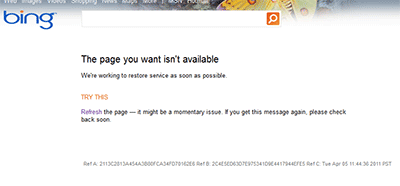
I worked on Bing for a while longer, resubmitting my last page in the hopes that Bing would come back to life while my work still existed. No luck. In fact, when I accessed Bing in other browser tabs, I discovered that in addition to the business database’s lifelessness, Bing’s search customization program was also down. The search customization screens also let you enter your preferences, but when you attempted to update your account, you were told that the page you were looking for was not available (see graphic, above).
Throughout the Bing FAIL, the news radio talkers would hype the headline of the Google’s Federal troubles.
I just wanted to scream at the radio. It’s not Google’s fault that they are dominant in the marketplace. Their stuff works!